For business, winery & farm
Commercial & Agricultural Solar in Kelowna, BC
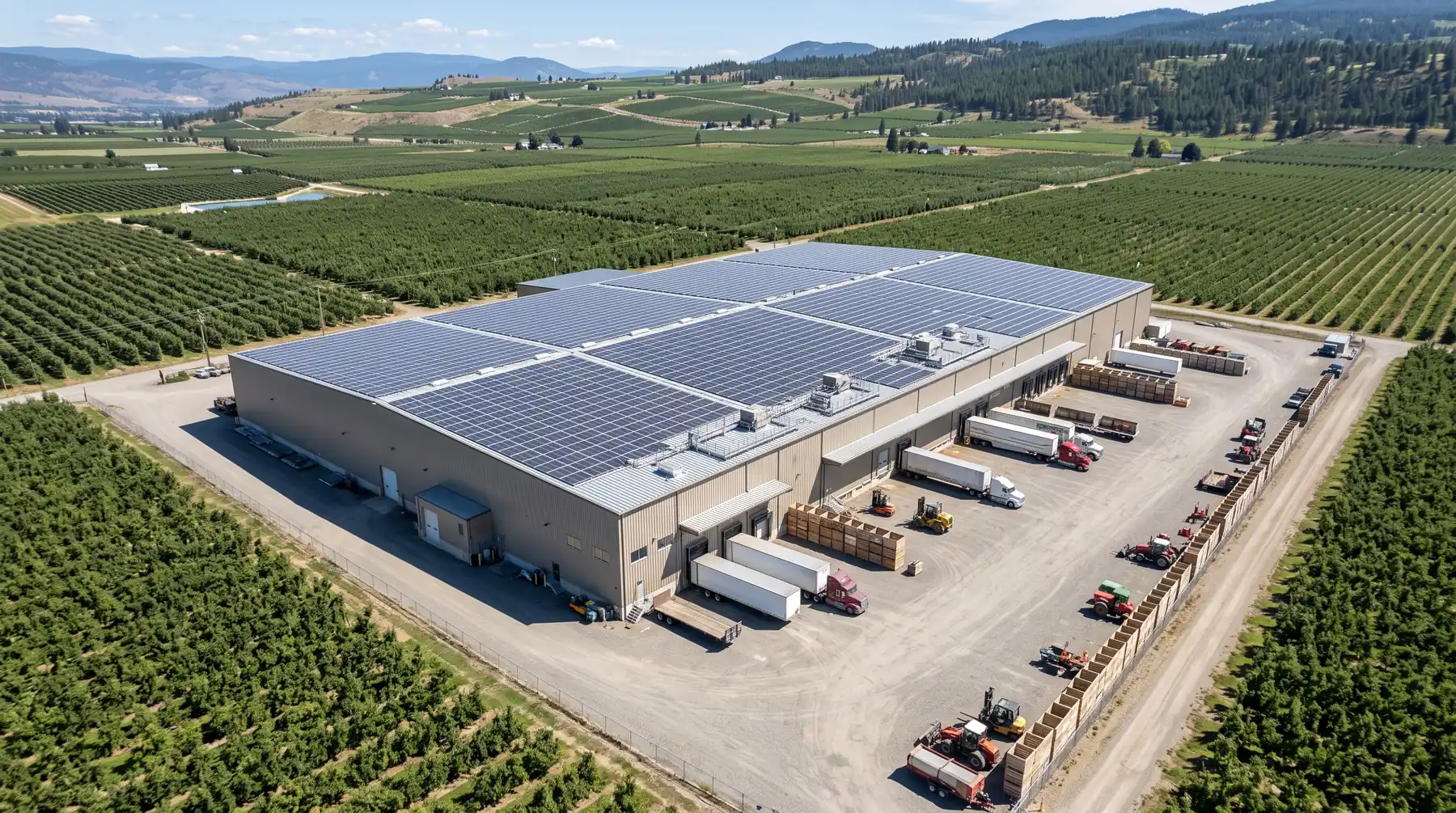
Warehouse roofs, winery buildings and orchard sheds across the Central Okanagan are some of the best solar sites in the province. Most are still bare.
Solar for Central Okanagan Businesses, Wineries and Orchards
A commercial bill has two parts: the energy you use, and demand charges set by your highest draw. For a lot of Okanagan operations that peak arrives on a hot July afternoon, when a south-facing array is producing close to its maximum. That overlap is why commercial solar often pays back faster than residential.
The Westside wine trail, the orchards of southeast Kelowna and Lake Country, and the light-industrial parks off Highway 97 all share the same useful features: wide roofs or spare ground, and heavy daytime load from cooling, irrigation, compressors or refrigeration.
We design for packing houses, wineries and tasting rooms, cold storage, workshops, small manufacturers, retail buildings and strata complexes. A commercial quote is never a scaled-up house quote. Roof structure, three-phase service and the rate class you are on can all change the answer.
BC Hydro commercial customers may qualify for up to $10,000 in rebates, and new BC Hydro systems up to 100 kW go on self-generation, which pays 10¢/kWh for exported power. FortisBC commercial customers get net metering on systems up to 50 kW. Because a business uses most of its solar power as it is made, the export rate matters less here than for a house.
Call 250-250-2525 with a recent power bill and we can usually give you a rough system size and payback over the phone.

What a Commercial Project Includes
Interval and demand analysis
We look at when you use power, not just how much. Cutting a demand peak can be worth more than cutting kilowatt-hours, and that changes how the array is sized and oriented.
Roof or ground-mount design
Older packing sheds and barns were never built to carry extra load. On farm properties a ground-mount in the headland is often cheaper to maintain and produces more.
Structural engineering
Before anything goes on a commercial roof, we confirm it can take the added dead load plus local snow load, with engineer sign-off where it is required.
Three-phase electrical and interconnection
Three-phase work by licensed electricians, permits pulled, and every system commissioned to FortisBC or BC Hydro interconnection requirements.
Rebate and program paperwork
The BC Hydro commercial rebate where it applies, the net-metering or self-generation application, and utility coordination on larger systems.
Monitoring and reporting
String-level monitoring with reports you can hand to an accountant, a lender or buyers who ask for sustainability figures.
Commercial Solar Costs
| System size | Suits | Installed cost |
|---|---|---|
| 20 kW | Shop, tasting room, small office | $46,000 – $60,000 |
| 50 kW | Winery, packing house, mid-size facility | $110,000 – $145,000 |
| 100 kW+ | Large agricultural or industrial site | from $210,000 |
Per-watt cost falls as systems grow, but structure, electrical service and mounting vary more between commercial sites than between houses. Every commercial price follows a site assessment.
Commercial systems usually pay back faster than residential ones: higher daytime use, demand-charge savings and better pricing at scale all push the same way. Ask your accountant how capital cost allowance applies, alongside our numbers.
Why Businesses Work With Us
Demand charges modelled
Many proposals leave them out. For a lot of commercial accounts, that is where most of the saving is.
Agricultural buildings are routine
Packing sheds, barns, winery buildings and irrigation pumps, including an honest call on when the ground beats the roof.
Licensed, permitted, commissioned
Carried out by our team and our vetted contractor partners, to the utility’s interconnection rules.
One point of contact
From the first bill review to commissioning you deal with one person, not a string of subcontractors.
Find out what solar would do to your power bill.
A free estimate starts with a short phone call. No pressure and no obligation, and you get a straight answer either way.
How a Commercial Project Runs
- 1
Bill and load review
Twelve months of use and demand data, often enough for a first estimate of size.
- 2
Site and structure
Roof, electrical room, three-phase service and available ground.
- 3
Design and payback model
System size, output, demand impact, rebate and payback, in writing.
- 4
Permits, build, commissioning
Utility coordination, installation, inspection and handover.
Commercial timelines depend mostly on structural review and utility approval. You get a realistic schedule with the quote.
Areas We Serve
Commercial & Agricultural Solar throughout Kelowna, West Kelowna, Lake Country and the wider Central Okanagan.
Our Other Services
- Residential Solar Panel InstallationGrid-tied rooftop solar for Kelowna houses, sized to your twelve-month usage. From $10,000 installed.
- Off-Grid Solar SystemsComplete stand-alone power with a battery bank and generator backup, sized for December rather than July.
- Solar Battery Storage & Backup PowerBackup for essential circuits during outages. New systems, or batteries added to solar you already have.
- Solar Panel Repair, Cleaning & MaintenanceOutput diagnosis, inverter replacement, cleaning and inspections, including on systems we didn’t install.